
Industrial blower rotation direction is the way the impeller turns, clockwise or counterclockwise, and it must match the arrow on the casing. Run it the other way and even the best industrial blower delivers far less airflow.Think of the impeller as a water wheel for air. Its curved blades catch air and throw it outward into the housing. Spin it backwards and the blades work against their own shape, so the air isn’t thrown out cleanly.
This guide explains how a blower moves air, what rotation direction means, how to check it and how to fix it.
Table of Contents
- How an industrial blower moves air
- What rotation direction means (CW vs CCW)
- How to read the rotation arrow
- Why the wrong direction cuts airflow
- Signs your blower is running backwards
- Rotation direction vs discharge position
- How to check and correct rotation direction
- Common mistakes to avoid
- FAQs
1.How an industrial blower moves air
Air enters at the center of the impeller, is thrown outward by the spinning blades, and is guided by the housing toward the discharge. Figure 1 shows the full path.
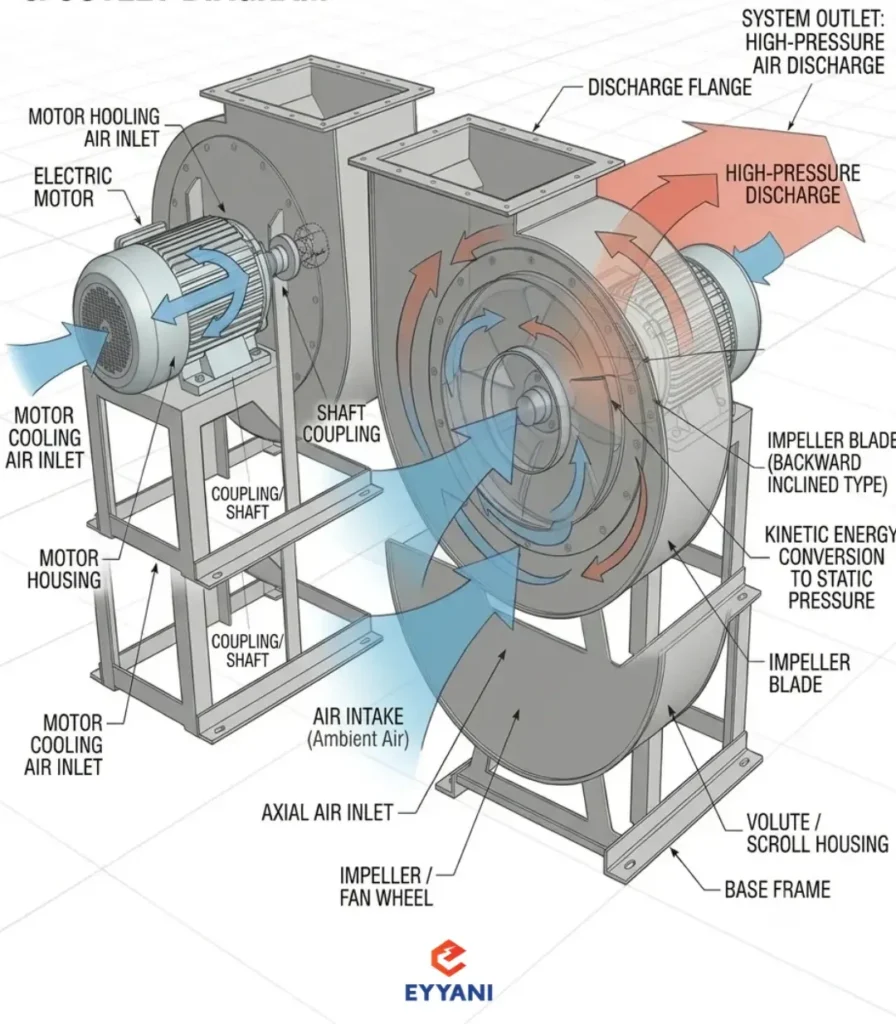
The main parts in the diagram:
- Axial air inlet: air is drawn in at the center of the impeller.
- Impeller (fan wheel): the blades give the air speed.
- Volute (scroll) housing: the widening casing turns that speed into pressure.
- Discharge flange: high-pressure air leaves here and enters your duct.
- Motor and shaft coupling: the motor drives the impeller. The motor has its own cooling air inlet, separate from the air the blower moves.
- Base frame: holds the motor and blower in alignment.
2. What rotation direction means
Rotation direction is the way the impeller turns, either clockwise (CW) or counterclockwise (CCW). By convention it’s judged while looking at the blower from the drive (motor) side. A blower is built for one direction only. The impeller blades and the scroll housing are designed as a pair, so the correct direction is the one that carries air along the housing toward the discharge.
3. How to read the rotation arrow
Look for the arrow on the casing or the nameplate. It shows the correct direction of rotation. As a quick visual check, the impeller should turn so that air is carried around the housing toward the discharge flange, as in Figure 1, not back against the point where the housing narrows.
4.Why the wrong direction cuts airflow
The blades in Figure 1 are backward-inclined, shaped to guide air smoothly as it leaves the impeller. Reverse the rotation and they can’t do that job, so Airflow and pressure drop sharply Noise and vibration can increase Motor current can differ from the nameplate value, so the motor isn’t working as designed The blower still moves some air, which is why a reversed blower is often missed.
Signs your blower is running backwards
1.Much less air at the discharge than expected
2.Louder or rougher sound than normal
3.Poor performance even though the motor runs smoothly
4.Airflow that doesn’t match the rated figure for the model
If you see any of these, check the rotation direction first before suspecting the blower itself.
Rotation direction vs discharge position
These are two separate things:
1.Rotation direction is which way the impeller turns (CW or CCW).
2.Discharge position is where the air leaves the housing, such as top horizontal or bottom vertical.
Changing the discharge position doesn’t fix a wrong rotation, and reversing the rotation doesn’t change where the air exits. When you specify a blower, you need both.
7. How to check and correct rotation direction
1.Isolate and lock out the power before touching anything.
2.Clear the area and make sure nothing can be drawn in or thrown out by the impeller.
3.Jog the motor for a second or two, with no one near it, and watch the direction of the impeller or motor fan.
4.Compare it with the arrow on the casing.
If it’s reversed on a three-phase motor, switch off, isolate again, and swap any two of the three supply wires. Then jog again to confirm. For single-phase motors, follow the motor’s wiring diagram, since reversal depends on the model. Have a qualified electrician do the wiring change, and confirm the correct direction before running the blower under load.
8. Common mistakes to avoid
Assuming the motor fan direction is the impeller direction. Always confirm from the drive side and match it to the arrow.
1.Running the blower for a long time to “test” it. Jog briefly, correct, then confirm.
2.Confusing discharge position with rotation. Check both against the order.
3.Skipping the check after maintenance. Rewiring or replacing a motor can reverse the direction.
4.Ignoring low airflow. A reversed blower can look healthy while underperforming.
Need the right blower for your system?
Eyyani manufactures industrial blowers in Bangalore, tested before dispatch and supplied across India. Explore our industrial blower range or contact us for a quote and we’ll help you choose the right size, rotation and discharge position.
Short test runs are usually fine, but running in reverse for long periods can cause vibration and overload, so correct it right away.
Check the arrow on the casing or the nameplate. Direction is normally judged from the drive side.
Isolate the power, swap any two of the three phase wires, and test again with a short jog
You need the required airflow (m³/hr or CFM), static pressure, air temperature and the application. The type of gas or fume, motor voltage and available space also help.


